
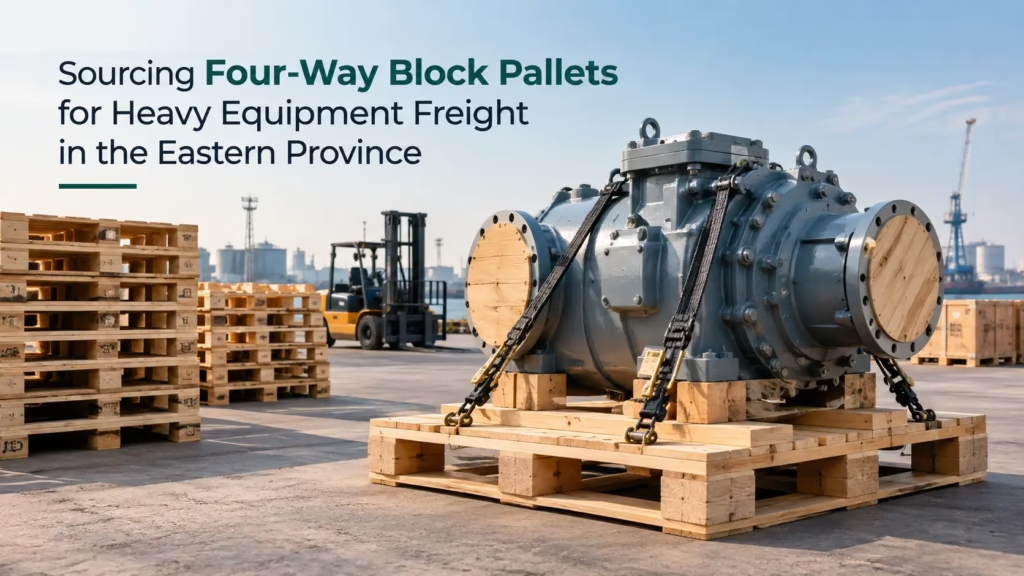
Sourcing Four-Way Block Pallets for Heavy Equipment Freight in the Eastern Province
A Procurement and Engineering Guide for Oilfield, Petrochemical, and Heavy Industry Logistics in Jubail and Dammam
Anyone who has managed freight for an Eastern Province refinery knows the moment: a pallet cracks under a valve assembly halfway through a rack stack, and suddenly a routine delivery turns into a damage report, a delayed shipment, and a conversation with a client who wanted their equipment yesterday. It happens more often than procurement teams like to admit, and it almost always traces back to the same root cause, deploying the wrong pallet configuration under a high-mass industrial load.
For companies moving multi-ton machinery through SABIC and Saudi Aramco downstream supply chains, pallet selection isn’t a packaging afterthought. It’s a structural decision with real consequences for cargo integrity, port clearance times, and warehouse safety. This comprehensive guide looks at why the heavy-duty four-way block pallet has become the default standard for industrial freight across our regional hubs, including wooden packaging in Jubail and wooden packaging in Dammam. The perspective here comes directly from the manufacturing floor at Noor Wood Works, where these compliance and handling protocols get tested daily against real shipments, not spec sheets.
The Structural Anatomy of a Heavy Equipment Block Pallet
Not all packaging assets are built for the same job, and the structural difference between standard stringer wooden pallets and a true block pallet configuration comes down to how each architecture distributes weight.
A stringer pallet relies on three or four parallel wooden beams running the length of the platform. That works fine for light, uniform loads moving through a commercial retail distribution center. It does not work for a downhole drilling assembly or a compressor housing, where the load is concentrated, uneven, and often shifts during transit.
Instead, heavy-duty industrial shipping demands a platform with multi-directional entry points. Utilizing four-way entry pallets solves this with solid timber blocks positioned at the corners and center, each one engineered to absorb localized structural stress rather than transferring it along a single beam line. When a multi-ton valve sits on a block pallet, the weight gets distributed across nine distinct contact points instead of three or four.
The deck boards matter just as much. While standard multi-trip pallets typically use mixed softwoods, high-capacity industrial systems transition to dense, structural timber bases. In highly demanding scenarios, switching the platform surface to plywood packaging profiles provides high anti-deflection resistance under sustained, massive compression. Fastener choice rounds out the structural engineering: helical-threaded nails driven cross-grain hold the assembly together under repeated loading cycles in a way that standard smooth nails simply can’t match.
| Engineering Specification | Standard Multi-Trip Pallet | Heavy-Duty Block Freight Pallet |
| Material Grade | Mixed softwoods / light pine | High-density kiln-dried hardwood / plywood |
| Static Load Threshold | 1,500 – 2,500 kg | 8,000 – 10,000 kg |
| Dynamic Load Threshold | 1,000 – 1,250 kg | 3,000 – 4,500 kg |
| Handling Access | 2-way or limited 4-way | True 4-way entry (block configuration) |
The gap in load ratings isn’t marginal; it’s the difference between a pallet that fails at 1.2 tons and one that holds firm past 8 tons. For logistics managers, understanding materials used in wooden packaging and why they matter is the first step toward preventing catastrophic structural failures on the plant floor.
Eliminating Terminal Friction: Forklift and Pallet Jack Accessibility
Structural strength solves half the problem. The other half plays out on the ground, at marine ports and warehouse bays where minutes of staging time add up across hundreds of shipments a week.
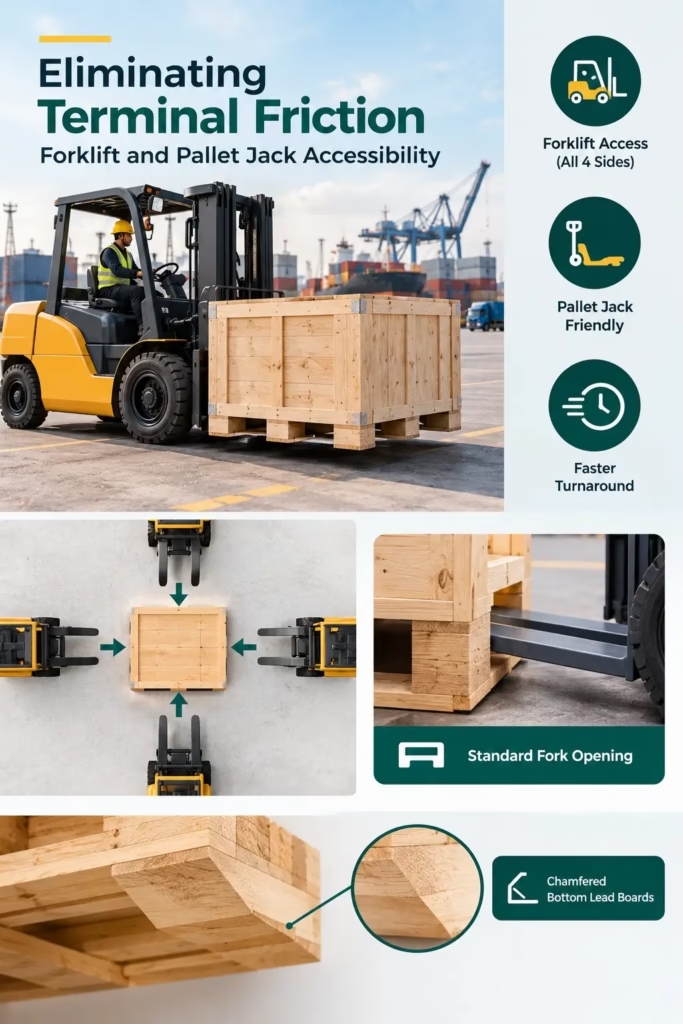
King Abdulaziz Port in Dammam and the logistics terminals feeding Jubail Industrial City move enormous volumes of heavy equipment freight. Every extra maneuver a forklift operator has to make around a badly configured pallet is time the whole yard pays for. Proper four-way block configuration removes the rigid stringer beams that block lateral access, allowing forklift and pallet jack operators to approach from any of the four sides rather than being restricted to the two ends. In a congested staging area, that operational flexibility is what keeps a queue of flatbed trucks moving instead of backing up.
Fork opening dimensions matter here too. Heavy-duty block pallets are built to standard openings compatible with high-capacity forklifts, reach trucks, and hydraulic pallet jacks already in service across the industrial zone. This means no improvising with mismatched equipment, and no operators forcing steel tines into a gap that wasn’t designed for them.
Furthermore, the chamfered bottom lead boards, a small detail easy to overlook on a procurement spec sheet, do real work in practice: they let forklift tines glide smoothly under the pallet instead of catching on a squared edge, which is the primary cause of cracked bottom boards during repeated handling.
Navigating SABIC and Saudi Aramco Supply Line Compliance
None of the structural advantages matter if an international shipment gets held at an industrial checkpoint over faulty paperwork or a missing stamp. Compliance is where procurement teams either save themselves weeks of delay or create them.
- Dimensional Compliance: SABIC and Aramco facilities run automated racking systems tuned to specific footprints — generally $1200 \times 1000\text{ mm}$ or $1200 \times 800\text{ mm}$. Exporters often opt for standardized euro pallets to align seamlessly with automated rack interfaces. Confirming footprint compatibility before an order goes to production, not after, saves massive re-packing overhead.
- Phytosanitary Certification under ISPM-15: This is non-negotiable for any solid wood block runners crossing a border. Read the detailed breakdown on ISPM-15 Compliance in Saudi Arabia: A Complete Guide to understand the core heat-treatment parameters (56′ sustained for at least 30 minutes) required to eliminate wood-boring pests. Skipping this step is the fastest way to have an entire container held at customs.
- The Legible IPPC Stamp: Every pallet needs a clear, legible heat-treatment mark, no smudged stamps, and no missing units in a mixed pallet order. Customs officers at land borders and port checkpoints check for this specifically. Failing to secure these stamps highlights the risks of ignoring ISPM-15 and SASO wooden packaging standards in Saudi Arabia, which can trigger administrative holds on entire cargo vessels.
Heavy Equipment Applications: Safeguarding Valves and Drilling Assemblies
The theory behind block pallet design only matters in how it holds up against actual heavy cargo challenges across the Eastern Province and neighboring GCC routes, such as transit via Bahrain wooden packaging cross-border channels.
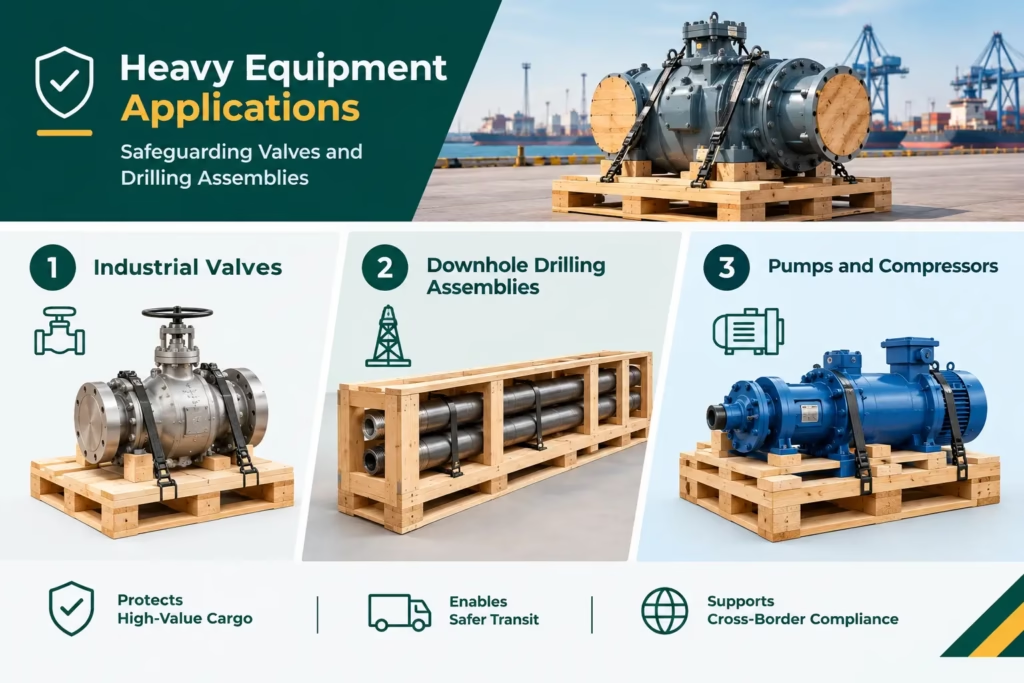
- Industrial Valves: These are a prime example of concentrated dead weight. A single large valve assembly can put its entire mass on a footprint of a few hundred square centimeters. Reviewing technical insights on Aramco Standard Wooden Packaging: How Noor Wood Works Delivers demonstrates how a distributed support structure absorbs that concentration safely without fracturing deck boards partway through an overland haul.
- Downhole Drilling Assemblies: These components bring the challenge of lateral movement. They can roll or shift during transit if they’re not secured properly. For oversized components requiring completely enclosed protection, logistics teams integrate these layouts with heavy-duty wood crates and internal custom blocking to lock the cargo in place over long highway distances.
- Pumps and Compressors: These units combine both problems, significant weight and sensitive internal components that don’t tolerate severe transit vibration. Procurement agents can reference how can wooden packaging support SFDA compliance in Saudi Arabia to see how specialized structural setups isolate sensitive operational mechanisms from severe transit shock.
The common thread across these examples is that the heavy equipment itself costs significantly more than the truck carrying it. Treating pallet selection as an engineering decision protects your investment and ensures compliance with cross-border mandates, such as what SASO export standards are and why they matter to your Saudi business.
Procurement Checklist: Sourcing Your Block Pallets Direct from Dammam
Choosing a reliable supplier for industrial-grade freight packaging comes down to a handful of questions worth asking directly:
- Kiln-Drying Capability: Ask whether the manufacturer runs its own on-site kilns, and whether those kilns are set up to produce fully certified ISPM-15 timber consistently to meet global criteria, including why you should follow WTO packaging rules in Saudi Arabia.
- Daily Volume Throughput: A supplier that looks reliable on a small trial order can struggle once your shipment volume scales up during a busy export season. Ask about actual production capacity on automated fabrication lines, not just theoretical capacity.
- Raw Lumber Grade Flexibility: Not every shipment needs the heaviest hardwood available. A good vendor should be able to offer a strategic mix, softwoods for lighter freight, hardwoods or plywood sheathing for the heavy stuff, matched to your actual weight specs.
These questions separate suppliers who can support a long-term industrial account from ones who struggle to repeat quality consistency. A manufacturer that treats every order as a standard SKU is going to struggle the moment your shipment requires custom dunnage blocks or non-standard footprints for older warehouse racking.
Lead time is another point that deserves attention. Kiln-drying takes time to do properly; rushing the heat treatment to hit a shipping deadline is exactly how compliance issues slip through. A supplier who quotes an unrealistically fast turnaround on a large hardwood order is either cutting the treatment cycle short or drawing from an unverified stockpile. Neither is a safe choice for heavy-duty industrial accounts.
Conclusion and Strategic Next Steps
A heavy-duty block pallet isn’t an added cost on an industrial freight order, it’s insurance against the much larger cost of a damaged valve, a rejected shipment, or a container held at customs over a missing stamp. For logistics directors moving equipment through SABIC and Aramco supply lines, getting this one decision right upstream avoids a long list of problems downstream.
If you’re ready to move on this, browse the available configurations on our core block wooden pallets product page, or reach out through our request a quote gateway and our engineering team can run the specific load calculations required for your upcoming shipment.